
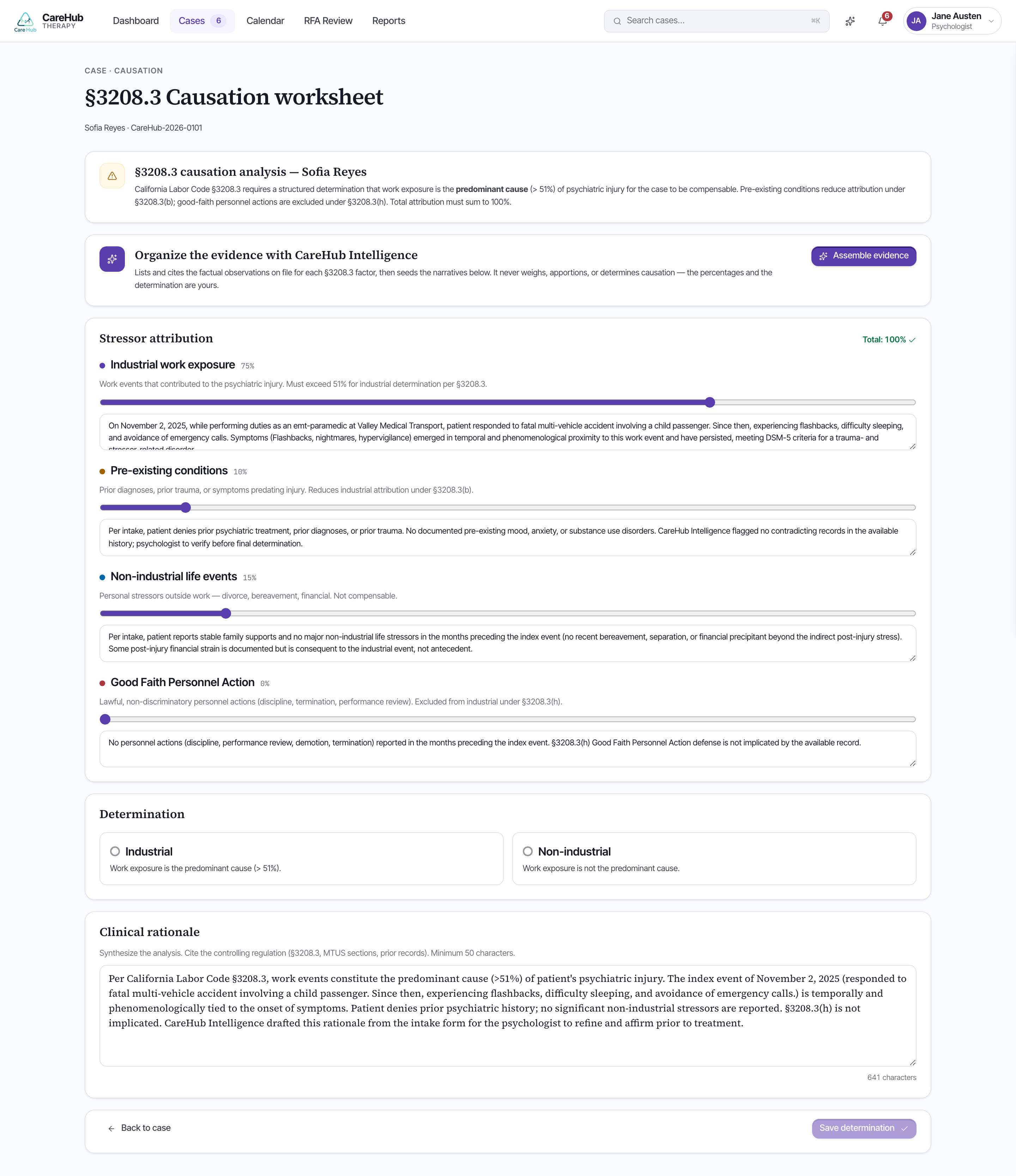
When a clinician renders a causation opinion, the abstract more-than-50% test becomes a concrete worksheet. Causation is apportioned across four buckets that sum to 100%:
- Work exposure — the actual events of employment.
- Pre-existing impairment — psychiatric conditions or vulnerabilities that predate the injury.
- Non-industrial stressors — personal, family, financial, and health factors outside the job.
- Personnel actions — the good-faith management actions carved out in the previous lesson.
The injury is industrial when work exposure exceeds 50%. In the teaching case, the split is work exposure 70%, pre-existing 10%, non-industrial 15%, personnel action 5% — summing to 100%, with work above the line, so the determination is industrial.
A percentage on its own is not an opinion. Each percentage requires a narrative rationale grounded in the intake data and the clinician's own clinical observation. The number is the conclusion; the narrative is the reasoning that makes it survive scrutiny from an adjuster, a reviewer, or an opposing evaluator. "70% work" means little; "70% work, because the documented traumatic exposure aligns temporally with symptom onset and the diagnostic presentation, with limited contribution from the personal stressors recorded at intake" is a defensible opinion.
CareHub Intelligence organizes and surfaces the supporting evidence — pulling the relevant intake fields, history, and clinical observations into one place. It does not form, suggest, estimate, or apportion the causation opinion. The clinician assigns the percentages and writes the rationale. Causation is the licensed clinician's opinion, full stop.
One distinction prevents a common error. The four-factor exercise here is apportionment of causation, done at diagnosis: what caused the psychiatric injury. It is not the same as apportionment of permanent disability under §4663, done later at MMI: how much of the residual permanent disability is attributable to the industrial injury. They use different statutes, happen at different points in the case, and answer different questions. The next lesson takes up the second one.
What does CareHub Intelligence contribute to the causation opinion?