
Whether a treatment is authorized turns on medical necessity, and in California medical necessity is defined by a published guideline hierarchy rather than a clinician's preference. That hierarchy is the MTUS (8 CCR §9792)the Medical Treatment Utilization Schedule — California's treatment-guideline hierarchy for workers' compensation. Treatment that aligns with the MTUS is presumptively reasonable; treatment that departs from it has to be justified against it.
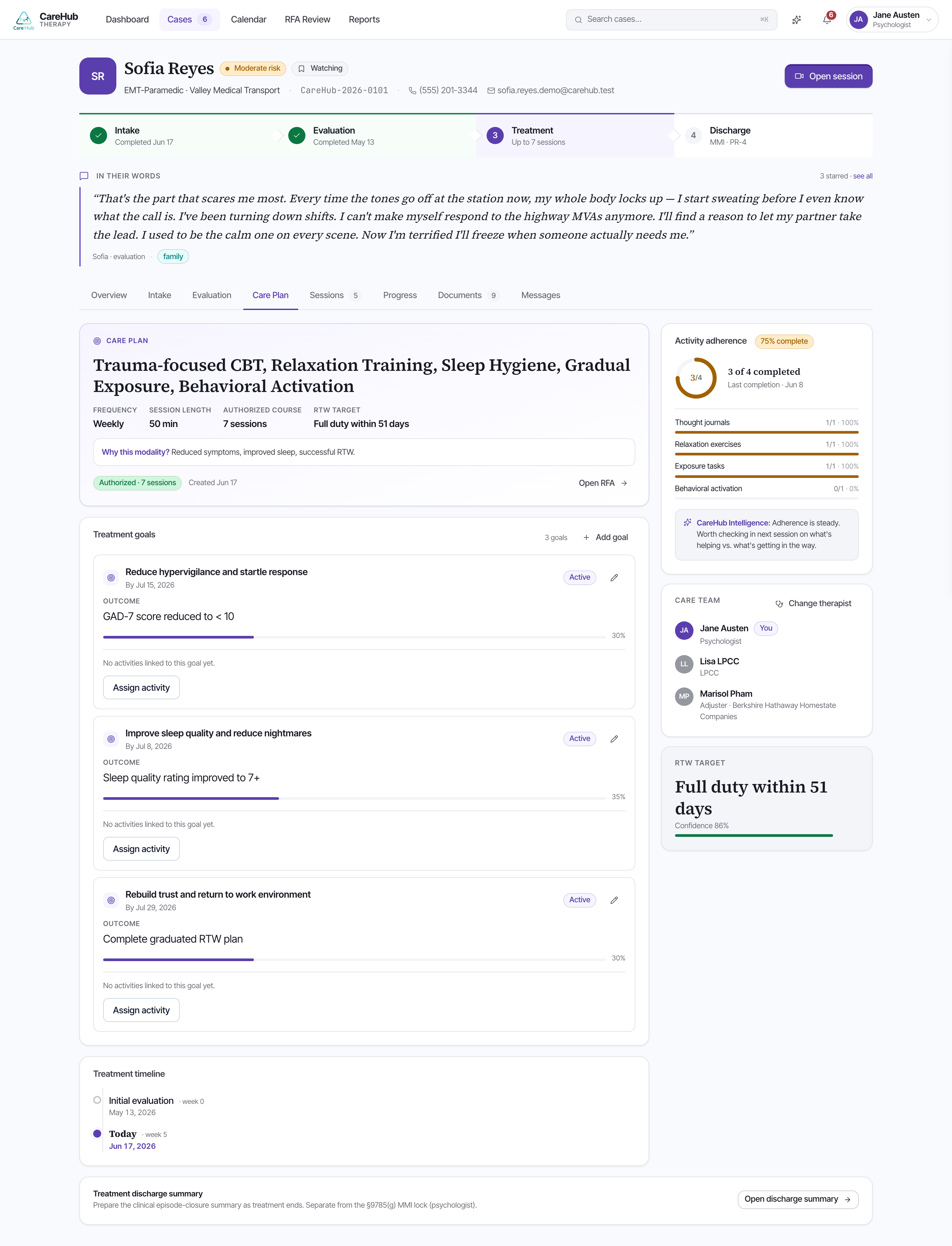
For the conditions this platform sees most, the MTUS is clear. Trauma-focused CBT is first-line for PTSD and adjustment disorders under §9792.24.2. The expected pattern is an initial trial of roughly 6–10 sessions with measurable progress by about session 4, with continuation authorized when documented progress supports it, under the continuing-care principles of §9792.23. This is why the structure of a care plan and the cadence of outcome measures are not bureaucratic overhead — they are the evidence that the treatment is working as the guideline expects.
The encounter itself is recorded with standardized procedure codes. The common psychotherapy CPT codes are 90791 (initial evaluation), 90832 (30 minutes), 90834 (45 minutes, the standard session), 90837 (60 minutes), 90847 (family therapy with the patient present), and 90853 (group). Choosing the right code is part of producing a clean, authorizable record.
When measurable progress stalls across four consecutive sessions, the case is evaluated for MMI. Plateau is not failure — it is a signal that the patient may have reached maximum medical improvement and the case should move toward its Permanent & Stationary determination rather than continuing treatment that the measures no longer support.
Sofia's course illustrates the standard working as intended: trauma-focused CBT, the first-line modality, with her outcome measures showing reliable movement through the initial trial — progress that supports continuation rather than a plateau toward MMI.
Under the MTUS, what is the first-line treatment for PTSD and adjustment disorders?