
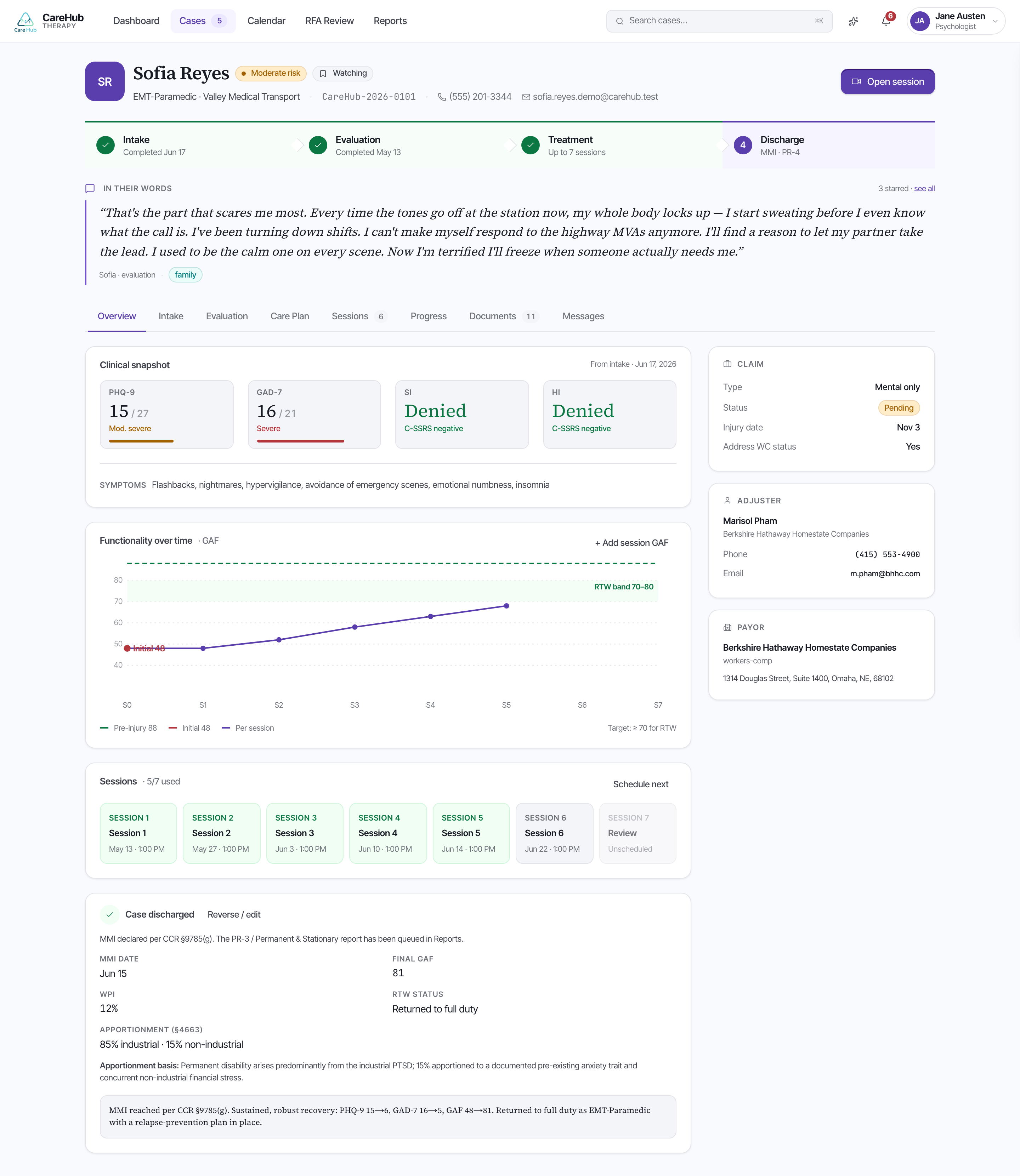
The case ends where Sofia's recovery plateaus. You declare MMIMaximum Medical Improvement (also P&S, permanent and stationary) — the point at which the condition is unlikely to improve further with treatment. when the condition has stabilized — for example, no measurable progress across four consecutive sessions, or all care-plan goals met. Sofia reaches it the second way: PHQ-9 down to 8, GAD-7 to 7, GAF up to roughly 70, the goals you set in the care plan achieved.
At discharge you record the final GAF, the WPIWhole Person Impairment, rated per the AMA Guides 5th edition, Chapter 14 for mental and behavioral disorders., the permanent restrictions, the §4663 apportionment, and the return-to-work status. For Sofia that's a final GAF near 70 and a return to modified duty.
§4663The statute requiring you to apportion permanent disability between industrial and non-industrial causes at MMI — a separate act from determining causation of the injury.Don't conflate the two apportionments. §3208.3 was about the causation of the injury, decided at diagnosis, gating whether the claim is industrial at all. §4663 is about the permanent disability that remains, apportioned now between industrial and other causes. Same patient, different question, different point in the case.
Recording these fields assembles the PR-4the §9785 permanent-and-stationary report (a PR-3 is used instead for pre-2005 injuries), due within 20 days of P&S. — your final word on the case, due within 20 days of declaring P&S. Mind that deadline the way the dashboard hero minds it for you.
So you close Sofia's case as you opened it: deliberately. The plateau is documented, the final GAF and WPI are recorded, the permanent disability is apportioned under §4663, and she returns to modified duty with a PR-4 that defends every number back to its source.
At Sofia's discharge you apportion her permanent disability between industrial and non-industrial causes. Which statute governs that act?