
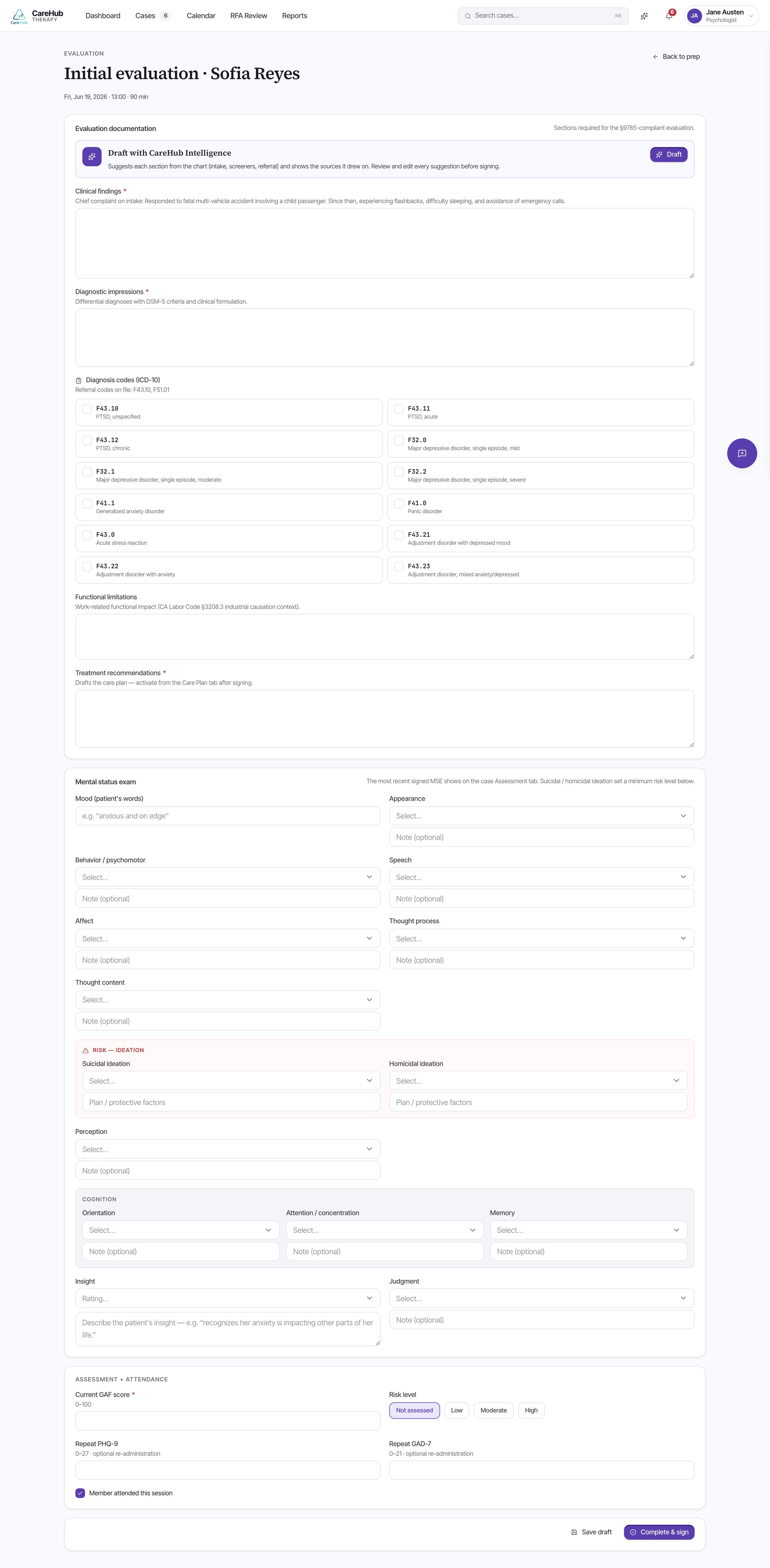
The review screen is where a draft becomes a record. It shows the authored report alongside its draft history, your edits on top of it, and citation chips that trace each statement back to the source data it rests on — a screener result, an intake answer, a flagged quote. You can follow any chip to confirm the claim is grounded before you stand behind it.
DFRThe Doctor's First Report — the §9785 document that a signed psychologist evaluation generates, alongside the PR-3.Signing is not a formality. It locks the note, records the timestamp, and closes the audit trail, and it captures provenance about the draft itself — whether it was machine-drafted and then clinician-edited. From that signature, the system generates the DFR / PR-3.
- Open the review screen and read the authored report top to bottom — every §9785 section, not just the ones you remember writing.
- Check the citation chips: follow any statement that matters back to its source data.
- Review the draft history and your edits so you know exactly what you are signing.
- Confirm causation, both GAF timepoints, and the functional limitations read the way you intend.
- Sign — this locks the note, timestamps it, closes the audit trail, and generates the DFR / PR-3.
A machine-drafted, clinician-edited note is still your professional opinion the moment you sign it — the system records that it was edited by you, but the responsibility for every word is yours. Read every section. The signature is the act that turns a draft into a record, and it is irreversible: the note locks.
Treat the read-through as the real work and the click as the small thing at the end of it. By the time you sign, you should be able to defend any sentence in the report to its citation — because once you sign, that report is what the case rests on.
What does signing the evaluation do, beyond approving the text?