
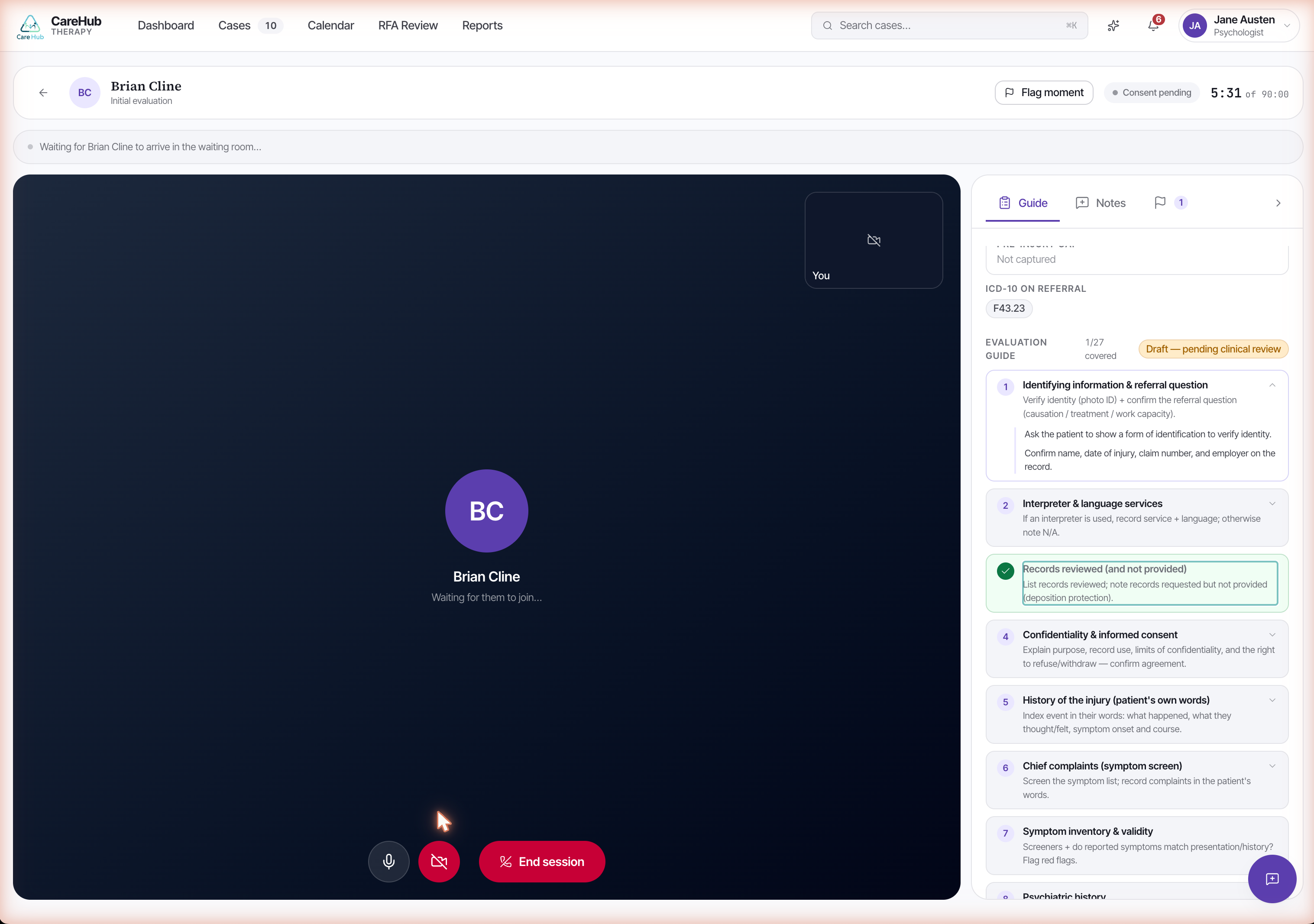
You conduct Sofia's evaluation in the live room, and a side panel keeps you on the rails of a complete report. That panel carries the evaluation spine — every section a defensible psychiatric evaluation needs, in order, each showing a readiness state so you can see at a glance what's done and what's still thin.
§9785The reporting regulation that defines what a treating-physician report must contain; CareHub's evaluation spine mirrors its required sections.The spine runs from presenting illness through history, the symptom inventory, psychiatric and substance history, the MSEmental status examination — the structured observation of appearance, mood, thought, cognition, and insight at the time of the visit., impressions, causation, GAF, functional limitations, treatment recommendations, and prognosis. You capture pre-injury and initial GAF here — for Sofia, a pre-injury 85 against an initial 52, the gap that quantifies her loss of function.
- Open Sofia's case at the evaluation slot; the live room opens with the §9785 spine in the side panel.
- Work top-down — presenting illness, history, symptom inventory, psych and substance history.
- Complete the MSE section from what you observe in the room.
- Record your impressions, then the causation section, then both GAF timepoints (pre-injury and initial).
- Document functional limitations, treatment recommendations, and prognosis as the conversation reaches them.
- Use Flag moment to mark any clinically important point with its timestamp for later review.
Document as the conversation happens rather than reconstructing it afterward — the spine is there precisely so you don't have to hold the structure in your head. When Sofia describes the pediatric fatality she couldn't save, that's a Flag moment: one tap pins the point with its timestamp, and you can return to it when you write impressions or causation.
Don't sign from memory of what you covered. Let the spine's readiness states confirm every required section is complete before you leave the room — a thin section caught now is far cheaper than one caught at signature.
Where in the evaluation do you capture Sofia's pre-injury and initial GAF?