
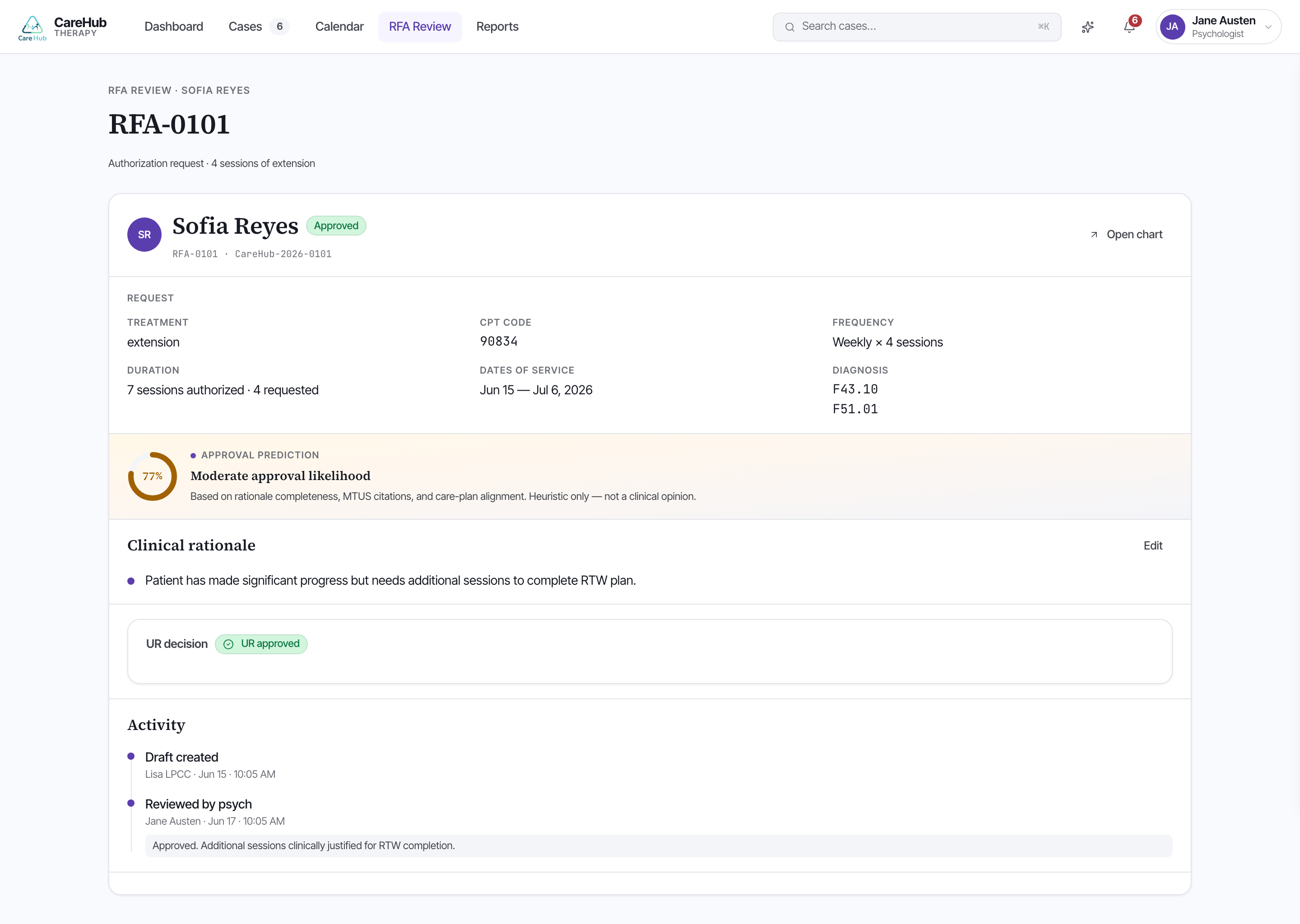
Sofia was authorized 7 sessions, and as she nears the end of them her LPCC judges she needs more. The therapist drafts a RFARequest for Authorization — the form that asks the payer to approve additional treatment. requesting 4 more sessions, and it lands in your RFA queue for review. The request can't go to the payer without your co-signature.
Your review is a clinical judgment, not a rubber stamp. Read the rationale the way the payer's reviewer will: does the progress on PHQ-9, GAD-7, and GAF support more treatment, is the remaining clinical work clearly stated, is the MTUS citation right, and does it connect to the return-to-work goal? For Sofia the story holds together — PHQ-9 down from 17 to 12 by session 6, GAD-7 from 16 to 11, GAF lifting from 52 toward the low 60s — movement that argues for finishing the course rather than stopping short.
You have two moves: co-sign, or return it to the LPCC with feedback to tighten the rationale before it goes out.
The moment you co-sign, the RFA submits to the payer and the §4610the utilization-review statute requiring the payer's UR decision within 5 business days. clock starts. If the payer misses that 5-business-day window, the requested treatment can be deemed approved — so a clean, well-argued RFA isn't just courtesy, it's leverage.
That's why a returned RFA is often the kinder outcome than a co-signed weak one: send it back, have the therapist sharpen the progress evidence and the MTUS link, and co-sign a version that either wins on its merits or wins on the clock.
You co-sign Sofia's RFA for 4 more sessions. What happens next?