
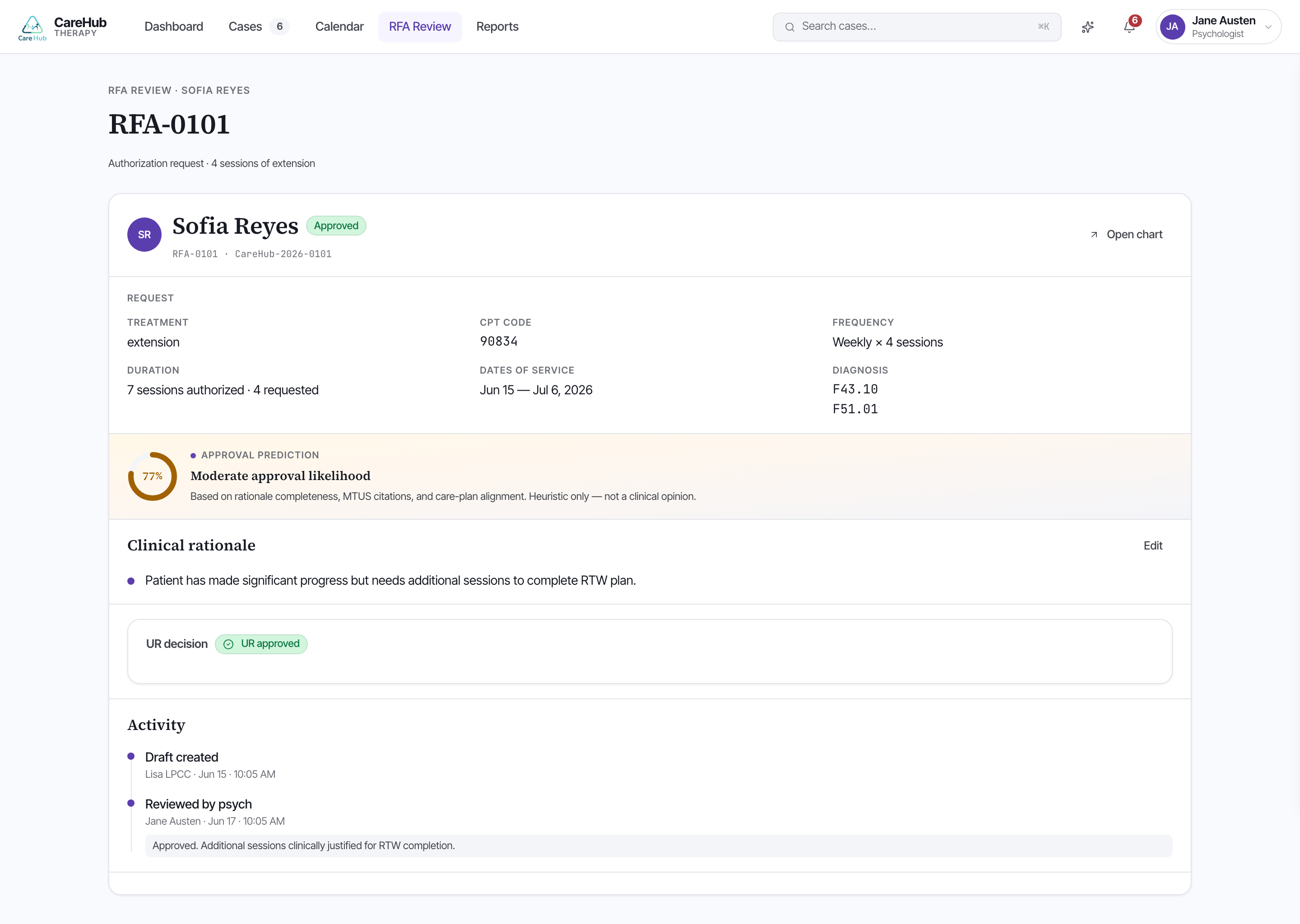
The authorized course of treatment is finite. Sofia started with seven sessions, and the data shows she is improving but not yet at goal. When the authorized sessions will not get the member to the finish line, you ask for more. That request is the RFA.
RFARequest for Authorization — the form that asks the payer to authorize more treatment and triggers utilization review.A persuasive RFA is a quantified one. State where the member started and where they are now: the PHQ-9, GAD-7, and GAF deltas from the Outcomes view. Name the remaining clinical work and why it needs the additional sessions. Cite the MTUS authority for continued treatment — §9792.24.2 for TF-CBT as first-line, or §9792.23 for continuing care. Link the request to the return-to-work target and the relevant dates. The reviewer should be able to read the case from the request itself.
Avoid vague language ("the member needs more sessions"), speculative claims you cannot support from the record, and any causation language at all. Causation is settled, psychologist-only, and out of scope for the RFA — raising it here only invites confusion. Let the measured progress and the MTUS citation carry the request.
You draft the RFA; you do not submit it alone. The psychologist co-signs it, and only then does it submit. On submission the §4610 utilization-review clock starts: the payer has 5 business days to render a decision, and if they miss that window the request is deemed approved.
- Quantify progress: pull the PHQ-9, GAD-7, and GAF deltas from the Outcomes view.
- State the remaining clinical work and the number of additional sessions needed.
- Cite MTUS — §9792.24.2 (TF-CBT first-line) or §9792.23 (continuing care).
- Link to the RTW target and the relevant dates; omit any causation language.
- Route to the psychologist for co-signature.
- On co-signed submission, the §4610 UR clock starts — 5 business days, deemed approved if missed.
For Sofia, you draft a request for 4 more sessions: PHQ-9 and GAD-7 both trending down by reliable change, GAF improved from 52 toward the mid-60s, remaining trauma-processing work to consolidate gains and reach her RTW target, cited to §9792.24.2. The psychologist co-signs, it submits, and the 5-business-day clock begins.
The payer does not respond to a properly submitted RFA within 5 business days. What happens?